By the CureWithAyurveda Wellness Team
Quick answer: Ayurveda sees the aches of desk work (a stiff neck, gritty eyes, a foggy brain by mid-afternoon) as signs of aggravated Vata dosha, the energy of movement and dryness. Long hours of stillness, screen glare, air conditioning and irregular meals all push Vata up. The Ayurvedic fix is a mix of warm oil massage for the neck and shoulders, eye rest and cooling eye care, a proper warm lunch as your main meal, short movement breaks and a steady daily rhythm.
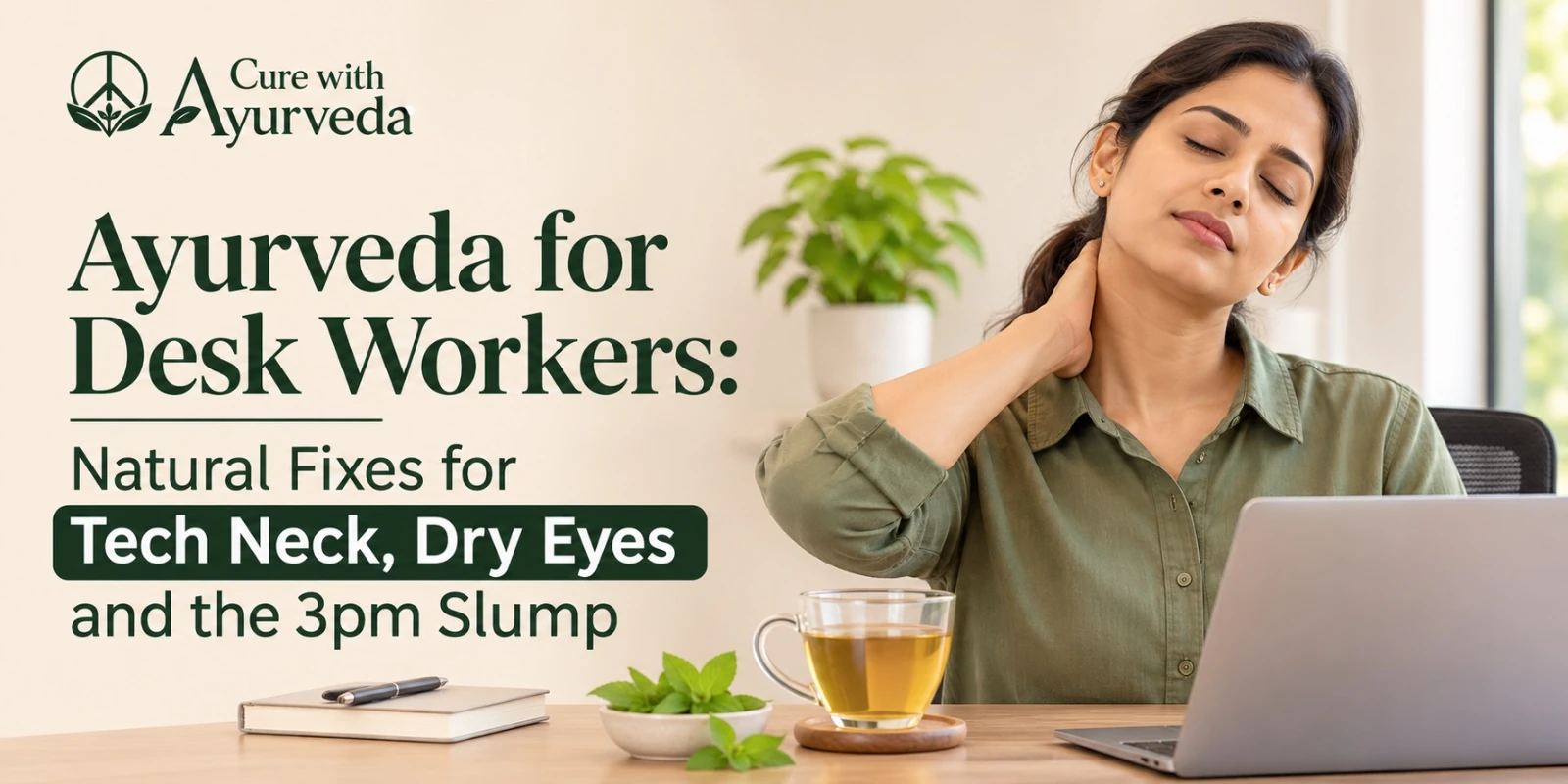
If you work at a laptop, you probably know the pattern. You start the morning sharp. By 11am your shoulders have crept up toward your ears. By lunch your eyes feel like sandpaper, and around 3pm you are reaching for a second coffee or something sweet from the cupboard. None of this is dramatic enough to call a doctor about, but it adds up, day after day, for years.
Ayurveda has a lot to say about this kind of slow, low-grade wear. It was written long before anyone sat in front of a monitor, but its core idea fits modern office life very well: the body gets out of balance through repeated daily habits, and it comes back into balance the same way. This guide explains what is going on from an Ayurvedic point of view and gives you a routine you can actually use between meetings.
Why does sitting at a desk all day make you feel so drained?
Sitting still for hours reduces circulation, tightens the muscles that hold your head up and keeps your eyes locked at one distance. Ayurveda describes this as Vata (air and space) building up in the body. Vata governs movement, the nervous system and dryness. When it rises, you get stiffness, dry eyes and skin, scattered focus and energy that comes and goes.
It might seem odd that sitting still raises the dosha of movement. The logic is that Vata gets disturbed by anything irregular or depleting, and modern desk life is full of both. Think about a typical workday:
- Air conditioning or central heating dries the air.
- Screens demand constant, fast mental processing.
- Meals get skipped, eaten late, or eaten while typing.
- Notifications break your attention every few minutes.
- The body barely moves, so circulation and digestion slow down.
Each of these on its own is minor. Together they create what an Ayurvedic practitioner would call a classic Vata picture. If your mind also races at night after a long screen day, you may recognise yourself in our guide to Vata-type stress and how to calm it.
There is a second layer. Hours of focused, competitive work can also heat up Pitta dosha (fire and water), especially in people who are already driven. Pitta shows up as red, burning eyes, irritability, headaches behind the eyes and acid in the stomach. Many desk workers have a bit of both: dry, tired Vata in the body and hot, overworked Pitta in the eyes and mind.
What is tech neck, and what does Ayurveda recommend for it?
Tech neck is the stiffness and pain that comes from holding your head forward to look down at a phone or laptop. In Ayurveda, it is treated as Vata lodged in the neck and upper back. The main remedies are daily warm oil massage (Abhyanga) of the neck and shoulders, gentle heat, neck movement through the day and fixing your screen height.
Your head weighs roughly as much as a bowling ball. When it tips forward, the muscles at the back of your neck and upper back have to work much harder to hold it. Do that for eight hours and the tissue gets tight, tired and sore. Many people also clench their jaw or lift their shoulders when concentrating, which adds to it.
Warm oil for the neck and shoulders
Ayurveda’s first answer to Vata stiffness is oil, applied warm. Oil is heavy, warming and smooth, which are the exact opposite qualities to Vata’s light, cold and rough nature.
Here is a simple version you can do in five minutes before your shower:
- Warm two teaspoons of sesame oil by standing the bottle in a mug of hot water for a few minutes. It should feel warm, not hot.
- Rub it into the back of your neck, the tops of your shoulders and the area between your shoulder blades that you can reach.
- Use long strokes down the neck and slow circles over the shoulder joints.
- Leave it on for 10 to 15 minutes, then shower with warm water.
Sesame oil is the traditional choice for Vata. If you run hot or have sensitive skin, coconut oil is cooler and lighter. Ayurvedic stores also sell herbal oils made for muscles and joints, such as Mahanarayan oil, which many people like for stiff necks. Do a patch test first, and skip oil massage on skin that is broken or inflamed.
Heat and movement during the day
You can’t oil your neck at your desk, but you can keep the area warm and moving. A scarf in an air-conditioned office helps more than you would think. Every hour, do a slow neck roll in each direction, drop your ears toward each shoulder and squeeze your shoulder blades together five times.
Fix the set-up, too
No oil will out-work a laptop sitting flat on a desk. Raise your screen so the top edge is at or slightly below eye level, keep it about an arm’s length away and use a separate keyboard if you work on a laptop. Ayurveda is practical about this. It treats your environment as part of your daily routine, not something separate from it.
Persistent neck pain, pain that runs down your arm, numbness, tingling or weakness should be checked by a doctor or physiotherapist. Those can point to a nerve problem that needs proper assessment.
How can Ayurveda help dry, tired eyes from screens?
Ayurveda links the eyes to Pitta dosha and to a subtype called Alochaka Pitta, which governs sight. Screen strain heats and dries the eyes, so the approach is cooling and moistening: regular breaks to look into the distance, palming, cool compresses, enough sleep and foods that support the eyes. Traditional eye therapies like Netra Tarpana are done only by trained practitioners.
When you stare at a screen, you blink much less than usual. Your eyes dry out, the focusing muscles stay contracted and the result is the gritty, heavy-eyed feeling at the end of the day.
The 20-20-20 habit
Eye care professionals widely recommend the 20-20-20 rule: every 20 minutes, look at something about 20 feet away for 20 seconds. It’s simple, it’s free and it lines up well with the Ayurvedic idea of giving overused senses regular rest. Set a gentle reminder until it becomes automatic.
Palming
Palming is an old yogic eye practice that many Ayurvedic teachers recommend.
- Rub your palms together briskly until they feel warm.
- Close your eyes and cup your palms over them without pressing on the eyeballs.
- Rest your elbows on the desk and breathe slowly for 30 to 60 seconds.
- Enjoy the darkness, then lower your hands and open your eyes slowly.
It takes a minute and is surprisingly calming for the whole nervous system, not just the eyes.
Cool compresses
Pitta responds to cooling. At the end of the day, lie down for five minutes with a cool, damp cloth over your closed eyes, or with chilled cucumber slices. Rose water on a cotton pad over closed eyelids is another common home practice. Keep these on the outside of the eyelid only.
What about putting things in your eyes?
You will see online advice to wash your eyes with Triphala water or put ghee drops in them. Classical Ayurveda does use eye therapies, including Netra Tarpana (a pool of medicated ghee held over the open eye) and specific eye drops. These are clinical treatments made under sterile conditions and given by trained practitioners. Home-made eye washes carry a real risk of infection, so please don’t try them in your kitchen. If your eyes are red, painful or your vision changes, see an optometrist or doctor.
Food for the eyes
Ayurveda traditionally values ghee, amla (Indian gooseberry), leafy greens, carrots and soaked almonds for eye health. Several of these happen to be good sources of nutrients that modern nutrition also links to eye health, such as vitamin A and lutein in leafy greens and carrots. A spoonful of ghee with lunch is an easy habit to start.
Why do I crash at 3pm, and how do I stop it naturally?
The afternoon crash usually comes from a heavy or poorly timed lunch, too little movement and blood sugar swings from caffeine and snacks. Ayurveda says digestion (Agni) is strongest around midday, so it recommends eating your largest, warm, cooked meal at lunch, taking a short walk afterwards and replacing the late coffee with a spiced herbal tea.
Ayurveda has a daily clock. Pitta, the fire principle, peaks between about 10am and 2pm. That is when your digestive fire is strongest and your body can handle your biggest meal. Then, from about 2pm to 6pm, Vata takes over. This is the time of day when spacey, scattered, tired feelings are most likely, especially if lunch was rushed or skipped.
So the 3pm slump has two parts in Ayurvedic terms. A poor lunch leaves you undernourished or weighed down, and then the Vata period amplifies the dip.
Make lunch the main meal
A sad desk sandwich or a skipped lunch followed by a big dinner is the reverse of what Ayurveda suggests. Try to make lunch warm, cooked and satisfying: a grain, a protein like lentils, beans, eggs, fish or chicken, cooked vegetables and a little healthy fat. Soups, stews, grain bowls and dal with rice all work well and can be packed from home.
If you often feel bloated or heavy after eating, our article on the signs of weak Agni and how to rebuild your digestive fire goes deeper into what is going on.
Eat away from the screen
Ayurveda puts as much weight on how you eat as what you eat. Eating while answering emails means you chew less, eat faster and barely notice when you are full. Even 15 minutes away from your desk makes a difference.
Walk for ten minutes after eating
A short, easy walk after lunch is one of the oldest pieces of Ayurvedic advice, called Shatapavali, which means “a hundred steps.” Modern research on walking after meals supports the idea that light movement helps with blood sugar after eating. It also gets you outside and away from the screen for a while.
Swap the 3pm coffee
Caffeine late in the day dries and stimulates Vata and can affect your sleep that night. Try one of these instead:
- Ginger and cinnamon tea: a few slices of fresh ginger and a cinnamon stick simmered in water for five minutes.
- CCF tea: equal parts cumin, coriander and fennel seeds steeped in hot water. It is a classic Ayurvedic digestive tea.
- Tulsi (holy basil) tea: widely available in tea bags in the US and UK, and traditionally used for focus and a calm mind.
A small handful of soaked almonds or dates gives steady energy if you need a snack.
What is the best Ayurvedic daily routine for office workers?
The best routine is one you can keep. Wake at a consistent time, do a short self-massage, eat a warm breakfast, make lunch your biggest meal, take a movement break every hour, eat a lighter dinner early and switch off screens an hour before bed. Consistency matters more than any single herb or practice.
Ayurveda calls the daily routine Dinacharya. The full classical version includes many steps, which few people with a commute and a 9am meeting can manage. Here is a stripped-back version for desk workers. For a fuller morning-to-night plan, read our realistic Dinacharya guide for busy people.
| Time | What to do | Why it helps |
|---|---|---|
| On waking | Glass of warm water, scrape your tongue, 5 minutes of stretching | Wakes up digestion and loosens the body after sleep |
| Before shower | 5-minute warm oil massage of neck and shoulders | Calms Vata and loosens stiff muscles |
| Breakfast | Something warm, like porridge or eggs | A steady start without a sugar spike |
| Every hour | Stand up, roll your neck, look out of a window | Breaks the stillness and rests your eyes |
| 12 to 1pm | Biggest meal of the day, away from the screen | Matches peak digestive strength |
| After lunch | 10-minute walk | Supports digestion and energy |
| 3pm | Herbal tea instead of coffee | Avoids the caffeine dip and protects sleep |
| End of work | 1 minute of palming, close the laptop fully | Signals the workday is over |
| Evening | Light dinner by 7pm, screens off an hour before bed | Better sleep and an easier morning |
You don’t need to start with every row. Pick two or three that feel easy, do them for two weeks and then add more.
Can desk work cause brain fog, and what helps?
Yes. Long hours of screen focus, poor sleep, skipped meals and little movement are common triggers for that cloudy, slow-thinking feeling. Ayurveda links brain fog to Kapha heaviness or Vata depletion clogging the mind’s channels, and uses steady meals, movement, breathwork, nasal oil and herbs such as Brahmi to clear it.
If the afternoon slump has turned into fog that lasts most of the day, it may need its own plan. Our Ayurvedic guide to brain fog and focus covers the different types and a 30-day reset.
A three-minute breathing break
Alternate nostril breathing (Nadi Shodhana) is easy to do at your desk and needs no equipment.
- Sit upright. Rest your left hand in your lap.
- Close your right nostril with your right thumb and breathe in slowly through the left.
- Close the left nostril with your ring finger, release the thumb and breathe out through the right.
- Breathe in through the right, close it, and breathe out through the left.
- That is one round. Do 8 to 10 rounds, slowly.
Many people find this calms a racing mind and sharpens focus at the same time. If you feel light-headed, stop and breathe normally.
Nasya for screen-heavy days
Nasya is the Ayurvedic practice of putting a few drops of oil in the nose. Ayurveda says the nose is the doorway to the head, and that a small amount of oil helps with dryness in the air-conditioned office and a clearer head. A simple version is to put one drop of plain sesame oil or a ready-made Nasya oil (Anu Taila is the classical one) on your little finger and gently coat the inside of each nostril in the morning. Avoid it if you have a cold, sinus infection or a blocked nose, and ask a practitioner first if you’re unsure.
Which Ayurvedic herbs support focus and energy at work?
Brahmi, ashwagandha, tulsi and Shankhpushpi are the herbs most often used in Ayurveda for focus, stress and steady energy. Tulsi is a gentle daily tea. Brahmi and Shankhpushpi are traditional brain tonics, and ashwagandha is used for stress and tiredness. Check with your doctor before starting any herb, especially if you take medication.
| Herb | Traditional use | How it is usually taken | A note of caution |
|---|---|---|---|
| Tulsi (holy basil) | Calm focus, resilience to stress | Tea, 1 to 2 cups a day | Generally gentle; ask a doctor if pregnant |
| Brahmi (Bacopa) | Memory, concentration | Capsules or powder | Can upset the stomach; may interact with some medications |
| Ashwagandha | Stress, low energy, sleep | Powder in warm milk or capsules | Not for pregnancy; can affect thyroid and other conditions |
| Shankhpushpi | Calm mind, mental clarity | Syrup or powder | Best taken under guidance |
Herbs work best on top of a solid routine, not instead of one. If you’re under constant pressure at work, our Ayurvedic guide to stress and anxiety covers the bigger picture.
How do I wind down after a long screen day?
Close your laptop at a set time, get some daylight or a short walk, eat a light early dinner and keep screens out of the last hour before bed. A warm foot massage with sesame oil, a cup of warm milk with nutmeg or a few minutes of slow breathing all help signal to the body that the day is over.
The hardest part of desk work is often that it never quite ends. The laptop stays open on the kitchen table and the phone keeps buzzing. Ayurveda is firm that the mind needs a clear transition from activity to rest, especially for Vata types.
Some ideas that work well:
- Create an end-of-day ritual. Write tomorrow’s top three tasks on paper, close the laptop and put it out of sight.
- Change your clothes. It sounds small, but it tells your brain that work is done, particularly if you work from home.
- Rub your feet. Ayurveda says massaging the soles of the feet with warm oil before bed calms Vata and helps sleep. Wear old socks afterwards.
- Dim the lights. Bright overhead lights and screens late at night keep the mind switched on.
If sleep is still a struggle, our Ayurvedic guide to insomnia and poor sleep has a step-by-step bedtime routine and a 21-day plan.
Does my dosha change what I should focus on?
Yes. Vata types tend to feel stiffness, anxiety and dry eyes first and need warmth, oil and routine. Pitta types tend to get burning eyes, headaches and irritability and need cooling and breaks. Kapha types tend to feel heavy and sluggish and need movement and lighter meals.
| Dosha | How desk work affects you | Focus on |
|---|---|---|
| Vata | Stiff neck, dry eyes and skin, scattered focus, anxious energy, cold hands | Warm oil, warm meals at regular times, a scarf, steady routine |
| Pitta | Red or burning eyes, headaches, irritability, acid after lunch, perfectionism | Cooling compresses, real breaks, less coffee, no skipped meals |
| Kapha | Heaviness, sleepiness after lunch, slow starts, weight gain from sitting | More movement, lighter lunch, ginger tea, standing for calls |
Not sure which one you are? Our free dosha quiz takes about three minutes and gives you a starting point.
A 7-day desk reset you can start Monday
If all of this feels like a lot, start here. Each day adds one habit on top of the previous ones.
- Day 1: Set an hourly reminder to stand up and look out of a window for 20 seconds.
- Day 2: Add a warm oil massage of your neck and shoulders before your morning shower.
- Day 3: Bring or buy a warm, cooked lunch and eat it away from your desk.
- Day 4: Take a 10-minute walk after lunch.
- Day 5: Swap your afternoon coffee for ginger, CCF or tulsi tea.
- Day 6: Do one minute of palming and five rounds of alternate nostril breathing before you log off.
- Day 7: Turn off screens an hour before bed and try a warm foot massage.
By the end of the week, notice how your neck, eyes and afternoons feel. Keep what works. Most people find two or three habits that make a clear difference, and those are the ones worth protecting.
When should I see a professional?
Home routines help with everyday stiffness and tiredness, but some symptoms need proper medical care. See a doctor or physiotherapist if you have:
- Neck pain with numbness, tingling or weakness in the arms or hands
- Headaches that are severe, sudden or getting worse
- Eye pain, redness that doesn’t settle, or any change in your vision
- Tiredness that lasts for weeks even with good sleep
- Any symptom that worries you
An Ayurvedic practitioner can also build a plan around your constitution, but they should work alongside your regular doctor, not replace them. If you’d like help putting together your own routine, you can get in touch with the Cure With Ayurveda team.
Frequently asked questions
Is Ayurveda good for neck pain from sitting at a computer?
Ayurveda can help with everyday neck stiffness from computer work. Warm oil massage, heat, regular movement and a better screen set-up are the main tools. Pain with numbness, tingling or weakness needs a medical check first.
Which oil is best for tech neck in Ayurveda?
Sesame oil is the traditional choice because it is warming and calms Vata. Mahanarayan oil is a popular herbal oil for muscles and joints. Coconut oil is a cooler option for people who run hot or have sensitive skin.
How can I reduce eye strain naturally at work?
Follow the 20-20-20 rule, blink often, use palming for a minute a few times a day and try cool compresses in the evening. Keep your screen at arm’s length with the top edge at eye level.
Why do I feel so tired after lunch at my desk?
A heavy, rushed or poorly timed lunch, little movement and caffeine swings are the usual causes. Ayurveda adds that the period from about 2pm to 6pm is Vata time, when energy naturally gets more scattered.
What is the best Ayurvedic drink for energy at work?
Ginger tea, tulsi tea and cumin, coriander and fennel (CCF) tea are good choices. They support digestion and steady energy without the crash that can follow coffee.
Can I do Abhyanga in the morning before work?
Yes. A short five-minute oil massage of the neck, shoulders and feet before your shower fits easily into a work morning. Leave the oil on for 10 to 15 minutes, then wash off with warm water.
This article is for general education and is not medical advice. Talk to your doctor before starting any new herb or supplement, especially if you are pregnant, breastfeeding or taking medication.